Student Work from Color Mixing for Dyers: Part II
Carol Soderlund is one of the top names related to hand dyeing. I first met Carol in Baltimore Ohio at a Crow Timberframe Barn Workshop. She is famous for the fabulous sample book her students create in Color Mixing for Dyers: Part I which includes 1029 colors and for the through understanding she has of both the esthetic and chemistry involved in creating those colors. Always with a gentle smile and a twinkle, she puts her students right to work and they love her for doing so.
Carol Soderlund Interview
Terry: Tell us about your path to becoming a nationally recognized authority on hand dyeing.
Carol: I have been dyeing fabric since 1988, when I was unable to find the gradation of gray to black I needed to complete my quilt Covenant. I had been shopping every weekend for months, and the fabric was just not out there! So with a two-page article (written by Jan Myers Newberry) in hand, I dyed 10 yards, and in less than 24 hours I had exactly the gradation I needed. That was inspiring to me. Even more inspiring and encouraging was the fact that the quilt went on to win the Best of Show/ Master's Division award at the Quilt Festival in Houston in 1989!
So I was off to the coloring races, as so many new dyers are, putting color on every piece of cotton in sight. In the early 90's I began teaching dyeing, primarily low water immersion techniques, in my home region of the Finger Lakes, and then around New York state. At the same time, because anything related to color was of intense interest to me, I devoted myself to a study of color and color theory, and learned about an approach to color theory that was three dimensional, a step beyond the 2D color wheels commonly used to depict color. While I found it fascinating, I also found it frustrating, because I wanted to see better models than were commonly available. I had the idea to dye myself a model of three-dimensional color, mostly for my own understanding.
Teacher sample of an overdye for Color Mixing for Dyers: Part II
I say "mostly," because around that time I had a notion to sign up for a class by Nancy Crow. I had been making art quilts for 12 years, but had only then gotten interested in finding out about Nancy's methods and style of quiltmaking. While contemplating bring her legendary supply list of 100 yards of solid-colored fabrics to class, I knew I would bring my hand dyes. When thinking about the wide variety of color I would need, I thought about my idea to make a color model, and thought--why not make the 3D color model, and then bring the resulting cloth to Nancy's class?
So I spent the next year sitting with my notebooks and pencils, books spread all around, figuring out how to create this color model in hand-dyes. Much testing and many trials ensued, and three weeks before class I started dyeing in earnest-nearly around the clock! I arrived at class with 343 yards of solid colors, all hand-dyed, and all represented in my dyeing notebook arranged in the 3D format. It was very fun to create this cloth, and thrilling to see the huge variety of hue and value emerge from the dyepot.
I had been teaching dyeing for 5 years already, but by doing this year-long project, I had made huge conceptual and technical leaps. It was very stimulating. And then I was challenged by Nancy to think about using the color I had created, and that was mind-expanding as well.
This was followed by offers to teach this color-dyeing system, both at Pro-Chemical and Dye (one of the suppliers for Procion MX dyes here in the US) and at the teaching facility that Nancy was starting on her farm in Ohio. So I embarked on another year-long process...designing a course that would simultaneously be a foundation course in dyeing with MX dyes, and a course in understanding color in a new way, and doing all the writing and preparation work for the course.
Student work from True Colors: Developing Your Personal Palette
Student's hand dye (left) with inspiration photo (right)
Terry: Do you have a philosophy of teaching? If so please share that.
Carol: I am a teacher by profession. I was a high-school teacher for 20 years, and I find that experience informs everything I do in the classroom. In the high school where I taught, we were required to set up every lesson using "learning styles" theory. In a few words this is the concept that every student has preferred ways of learning, and that it is not the same for every person. Some students learn auditorially, by hearing and then processing. Some learn visually, by reading and watching. Others kinesthetically, by doing. Some learn socially--by interacting with others, and so on. The most successful teacher will take all the variety of learning styles into account, and make sure that her lesson plan incorporates as many of the learning styles as possible--covering all the bases, so to speak.
My classroom is a joyful place. We do lots of laughing. We are coming together to create color on cloth, and what could be more joyful for a fiber artist than that? My students energize me and I love getting to know them. Inspiration flows both ways.
Student work from Color Mixing for Dyers: Part II
Terry: How do you keep your classes fresh?
Carol: Classes are never static. While in a given class there will always be the same basic concepts I am trying to get across, I will tweak and test different ways to accomplish that. Every so often I will totally revamp my handouts, as I learn new software. Presenting things beautifully is important to me! The needs of individuals students often inspire me to create a new project for an individual or a group. One of the best aspects of a workshop is everyone coming together with different backgrounds and goals.
The possibilities presented by the ways of looking at color are so vast I doubt I will ever run out of ideas. I am often testing and trying out new processes that will become the seeds of new classes.
Terry: What is the most important things you feel you must impart to a student?
Carol: Wow, this is a hard question, because it is tough to narrow it down. It will differ somewhat depending on the class. For example, though I am known for my class Color Mixing for Dyers, I also teach a class called True Colors: Developing Your Personal Palette. In this class we learn to mix color by eye, the way a painter does, with attention to the technical aspects of dye. We focus on the student's color inspirations and which specific primaries a student will need to create these colors. So each class will have specific coals I want to reach.
No matter which course I teach, I try to give a good foundation, because a student who understands the fundamentals is empowered to grow. Popular dye books contain accurate and sometimes inaccurate information--often in the same book. Coming to an understanding of
WHY processes work, and how to optimize them helps a student understand and sort it all out.
Terry: Do you ever take a workshop yourself?
Carol: Sure! I love to take workshops, and have a list of those I'd like to take someday. I especially like longer format workshops, 5 days or more, where you can really get into the subject. Fitting them into my teaching schedule is tough for me these days, but I will wedge on in whenever I can.
Terry: You have added several new courses to your offerings since I first me you. Which class do you love to teach most?
Carol: Gosh! That's like asking which of your children do you love most!!! I love the one I'm with!
Terry: I know you have focused on your teaching for several years. Have you still been able to continue creating quilts?
Carol: I am constantly thinking about the balance in my life--maybe it comes from being a Libra. In the last several years my life has definitely been weighted towards teaching, and away from my personal artwork. I don't teach during December, January and part of February, so this is my time for making quilts. During the rest of the year, I am gone up to two weeks a month, and home prepping the other two weeks. This is the hardest part about my teaching schedule. No--that's not true! Being away from home is the hardest part...No, flying is the hardest part...No, whatever the hard parts are, clearly I find teaching so personally rewarding that I continue to do it!
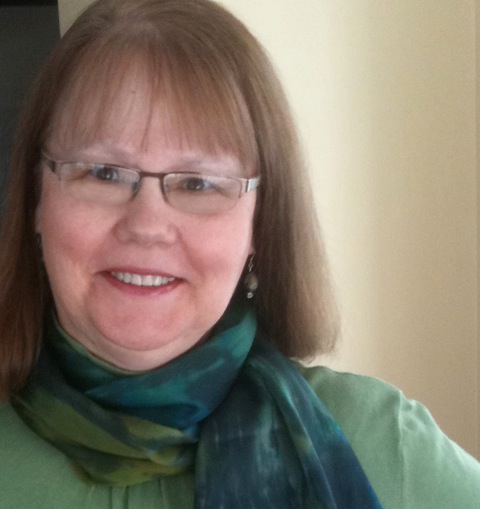
Carol Soderlund
Carol Soderlund maintains an active teaching schedule throughout the United States and in Canada, teaching her color mixing techniques at ProChemical & Dye in Massachusetts and Nancy Crow's Timber Frame Barn in Ohio and Pacific Northeast Art School in Washington. Her award-winning quilts have been exhibited nationally and internationally in such venues as Visions, the International Quilt Festival, and the Husqvarna Viking Masterpieces touring Exhibition.
For Carol, the ability to dye any color and the increased understanding of the interaction of colors opens the door to spontaneity and intuitive use of color in her work. It is this joyful key to color she hopes to give her students.
May 3-7 - Color Mixing for Dyers: Part 1
Crow Timber Frame Barn
May 10-14 - Color Mixing for Dyers: Part 2
Crow Timber Frame Barn
June 27 - July 3 - Dying to Discharge
Hudson River Valley Art Workshops
Thank you so much Carol. That was fun to hear about how you have built such a successful new career teaching a subject you love. I encourage anyone wanting to dive into dyeing for the first time (or for you more experienced dyers wanting to learn something new) to consider one of Carol's excellent workshops.
I appreciate your stopping by and we would love to hear your comments.